

There are two traits that I most commonly witness among the most successful collision business leaders I work with. First, they tend to work with a coach or mentor, and secondly, they engage in what is called deliberate practice.
I was first introduced to the concept of deliberate practice not on the shop floor as you might expect, but instead on the tennis court. When I began playing tennis regularly just a few years ago, I was completely hooked and would play and practice a lot, but felt my progress was slower than I would have liked. I was introduced to a coach that was unlike many of the other tennis professionals I had previously met. I thought this guy hated me! There were times I hated him, but in just a few months got me out of my rut and soon I was beating players that had been playing tennis for twenty years or more! What was it that made me improve to the point that I was beating far more experienced players? It was the not the amount of practice that mattered, it was how I practiced that mattered!
This may come as good news to many of you that scientific research has proven that your natural born talent has much less to do with your success in life than many think. The real secret to success at any endeavor whether sport, business, music, or others, lies in a person’s dedication to practicing the specific skills they have not yet mastered in a deliberate manner. This was great news to me as a tennis player, because trust me, I have very little natural athletic talent! The bad news is that deliberate practice can be tough! I’ll come back to that in a minute.
I am sure many of my readers can relate to what I am about to say. In past years I have been amazed how I would hire a person to work in my shop who says they have been in the business for twenty years or more and they have absolutely no more skill than the guy working next to them that has only been working in the trade for five years! What is up with that? For the most part, it is because in many trades it takes about 5 years to become proficient at your job, and then people take their foot off the gas and coast. It is like learning to drive. A person first goes through a cognitive phase where they have to think about everything before they do it. “Okay, now I have to press the gas pedal, and then turn on my turn signal etc.” You have to think about everything until it becomes a habit. Then a few years later you learn enough skills that you can drive the car all over town and without thinking about anything. The problem then is that people become complacent and quit learning new advanced driving skills. This same driver that has now become comfortably proficient at driving is still a very long way away from the skills that would be required to professionally drive a race car.
So back to the bad news. While my more experienced tennis opponents were still practicing the old skills they had already mastered because it’s fun, I was over on the next court over looking like an idiot and not having much fun trying to learn new skills that I was horrible at! But like the great Zig Ziglar famously said, “Anything worth doing is worth doing poorly until you learn to do it well.” Well I was quickly becoming the master of sucking at tennis! At least that is how it felt. For anyone to become truly great at anything, I am convinced that we have to learn to be okay at sucking at the things we have yet to master. The lessons I have learned from the tennis coach has translated into my business and my life in many enriching ways and it will yours too if you are willing to challenge yourself.
The journey to truly superior performance is neither for the faint of heart nor for the impatient. The development of genuine expertise requires struggle, sacrifice, and honest, often painful, self-assessment. There are no shortcuts. In Malcolm Gladwell’s book titled, Outliers, he indicates that it takes as much as 10,000 hours of deliberate practice to be considered an expert in a particular field.
So how does one engage in deliberate practice and how does it translate to the automotive repair business? It is easier to know how to engage in deliberate practice when we are talking about sports and music, but it is a little bit different when advancing your business skills. I believe that a great deal of the skills that I am considered an expert in are simply due to my own curiosity and drive to be the best. For example, many of my clients consider me an expert in the use of CCC One’s estimating and management software. What many of my clients don’t know is that I have spent many late nights discovering how to adapt this and other management systems to many different shop environments. I have made every mistake there is to make, tested various methods to perform many tasks in CCC One and I believe I still have more to learn! While some shop managers perform their daily duties and tasks exactly the same way every day, I perform every task with the intention of trying to do it better than the last time. Even if I am just doing the dishes! When it comes to some skills, deliberate practice is simply performing the duties you already have, but changing your mental approach to always want to perform it better. I have often said that the curious will rule the world, perhaps this is why.
Here are a few business related skills that coaching combined with deliberate practice can greatly improve your chances of becoming the best in your field, or at least in your shop.
- Holding crucial conversations and holding people accountable
- How to sell a repair job to a stubborn client
- How to sell an idea to a stubborn boss
- How to speak with charisma in front of your staff or in front of crowd
- Getting your people to buy into change initiatives
- Analyzing financial statements and running a business by the numbers
- Continuous improvement and the skills necessary to make people want to help you improve
- How to get rich!
By developing new skills and working on those things that are sometimes uncomfortable, you can actually change your mental mapping for how you approach things in life. You could quickly find a new lease on life and begin to live a more fulfilling life or at least you may find yourself in a similar situation as me with my tennis game. Beating a lot of opponents, but still feeling like I suck! Perhaps I should change my mental approach and look at it in a more positive light?
If you’re not sure what deliberate practices would most benefit you and your team, let an Elite Mentor help you figure out where to start! Contact us at david.luehr@elitebodyshopsolutions.com

Exploit – Use the paint booth as efficiently as possible.
- Try to always keep a car ready to roll in the booth so it never sits empty
- Have a car prepped and ready to paint first thing in the morning
- Hours of operation. Can you extend the hours the booth operates?
- Regular booth maintenance to eliminate mechanical failures (done after hours if possible)
- Regular booth cleaning and filters replaced (done after hours if possible)
Subordinate – Everybody in the shop knows the booth is to be catered to!
- Never send flawed work to the paint shop
- Always make sure the painter has the parts and paperwork he needs so he/she isn’t wandering around looking for it.
- Make considerations that will keep the painter in the booth spraying such as:
- Tinting outside the booth
- Mixing
- Masking
- Ordering product
- Body men are always aware when they must have their work shipped to the paint department
Elevate – Make the department or resource bigger
- Robotic drying equipment or other equipment to dry paint faster
- In some cases it may be preferable to add another booth or prep station
I think the best way to exploit the opportunities in your paint booth is through your scheduling habits. Far too many collision repair shops continue to bring a majority of their repair jobs in on Monday even though they know it is wrong! Most smooth running shops will paint close to the same number of vehicles every day. For our sample shop with sales of $150,000 that is going to equate to around 3-4 cars needing to be produced a day. A very achievable task for most shops with a single booth. However because of poor scheduling habits many paint departments continue to do almost no cars on Monday, start prepping a couple on Tuesday and then get completely overwhelmed on Wednesday afternoon and Thursday to get ready for the big “Friday Push!” It’s no wonder so many painters think they need another paint booth and a faster paint system when all they really need is for management to fix their scheduling habits.
Drum, Buffer, Rope
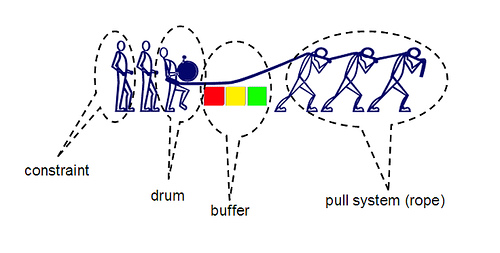
A Theory of Constraints analogy is what they call Drum, Buffer, Rope, (DBR) In the book called The Goal. Eli Goldratt uses a DBR story to describe how they keep a group of boy scouts marching at the same speed to ensure they all arrive at their destination at the same time as quickly as possible.
The Drum beat follows the speed of your constraint resource. An example of this, is that all body shop departments work to keep in pace with the paint booth.
The Buffer (a small buildup of work) ensures that the constraint never runs out of work. (Remember $893 an hour!)
The Rope is tied to your scheduling of work coming in. In other words, you schedule your repair jobs in as your constraint can begin working on it. As with lean thinking, scheduling too many repair jobs in leads to excess inventory (waste.)
___________________________
This article uses the example of the paint booth as the constraint resource because it is very common in our industry. However, this is not always the case, in fact, in many collision centers the office and blueprinting operations are commonly the bottleneck. So wherever your bottleneck is you can still use the same thinking to make sure you optimize your collision center for throughput and profitability.


